

How to Choose the Right Company Structure in the UAE (Trust vs SPV vs Offshore) 2026

Why Company Structure Matters More Than Jurisdiction
When people think about company formation, the first question they usually ask is: “Which country is best?”
But jurisdiction is secondary. Structure is primary.
Choosing the wrong company structure, even in the most favorable jurisdiction, can result in banking rejections, compliance failures, tax inefficiencies, legal exposure, and costly restructuring down the line.
The right approach treats company formation as legal architecture, not just paperwork. Your structure should be designed around function, risk, control, and future scalability.
Understanding the right company structure in the UAE is critical for banking approval, tax efficiency, and long-term asset protection.
This guide explains the differences between Trusts, Offshore Companies (IBCs), Foundations, SPVs, and Operating Companies, when to use each, and how to choose based on your actual business objective.
How Do You Choose the Right Company Structure in the UAE?
Before choosing between offshore, SPV, trust, or foundation, you must first define your business objective clearly.
Step 1: Start with Purpose, Not Cost or Geography
Before incorporating anything, the most important question to answer is:
What exactly am I trying to achieve with this entity?
Your objective determines your structure, not the other way around.
Running a Business? Choose an Operating Company
If the goal is actively generating revenue, contracting with clients, employing staff, or running day-to-day operations, you need an operating company.
Common use cases include consulting and advisory firms, trading companies, e-commerce brands, SaaS and technology startups, and agencies. Typical structures include UAE Free Zone companies, UAE Mainland companies, and International Offshore or IBC entities for non-UAE operations. The key considerations are banking access, licensing scope, compliance obligations, tax treatment, and operational scalability.
Protecting Wealth? Choose a Trust or Foundation
If the goal is asset protection, inheritance planning, or long-term family wealth governance, a trust or private foundation is the appropriate structure.
These entities create a legal separation between ownership and control, which is their core advantage. They offer strong asset protection, inheritance efficiency, and legal insulation from personal or business liabilities.
Holding Assets or Investments? Choose an SPV
If the goal is holding real estate, structuring startup investments, owning intellectual property, or isolating specific assets from the rest of your portfolio, a Special Purpose Vehicle (SPV) or holding company is the right tool.
The primary benefit of an SPV is risk isolation. It prevents legal, financial, or operational problems in one asset from contaminating others.
Earning International Income? Choose an Offshore Company or IBC with Layering
For global consulting, cross-border trading, IP licensing, international SaaS, or multi-jurisdiction revenue streams, an offshore or IBC structure combined with a holding company and SPV layer provides the most flexibility.
The focus here is tax optimization, regulatory arbitrage, and operational efficiency across multiple markets.
Step 2: Know When to Incorporate
Many founders rush into incorporation before they actually need it, often based on general advice that a company is always necessary, or that offshore structures automatically save tax. This frequently results in dormant companies, frozen accounts, and unnecessary compliance burdens.
Incorporation makes sense when there is a genuine operational need: contracts and commercial credibility, business banking and payment processing, legal protection and liability limitation, tax and regulatory optimization, or a clear path to international expansion.
If you are still testing an idea, validating market fit, or exploring demand, premature incorporation typically creates cost without corresponding benefit. Structure should follow business intent, not replace it.
Step 3: Understand What Differentiates These Structures
Structure | Legal Nature | Primary Function | Best Used For |
Trust | Legal relationship | Asset protection | Wealth, inheritance, legacy |
Foundation | Self-owned legal entity | Wealth control | Governance and asset holding |
IBC / Offshore Co | Standard company | Business operations | International trade and consulting |
SPV | Purpose-limited company | Risk isolation | Real estate, investments |
Operating Company | Licensed business entity | Revenue generation | Trading, consulting, services |
Step 4: Why Function Matters More Than Cost
The most common structuring mistake is choosing the cheapest option rather than the correct one.
A cheap structure applied to the wrong function leads to banking failures, compliance risks, tax inefficiencies, and costly restructuring. Getting the structure right from the outset is almost always less expensive than fixing it later.
Step 5: Real Structuring Uses Layering, Not Single Entities
Sophisticated structuring rarely relies on a single entity. Instead, it uses legal layering across multiple purpose-built vehicles:
- Trust or Foundation (ownership and protection layer)
- Holding Company (consolidation layer)
- SPVs (asset isolation layer)
- Operating Companies (revenue generation layer)
This architecture enables asset protection, risk containment, clean tax structuring, banking flexibility, exit planning, and succession efficiency, often simultaneously.
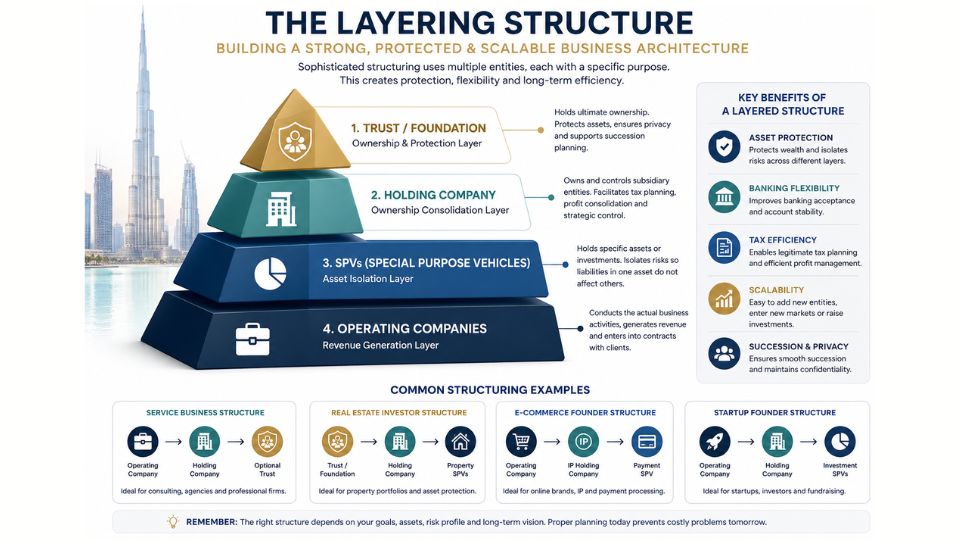
Common Structuring Scenarios
Commercial and Services Operating Company › Offshore Holding › Optional Trust
Real Estate Investor Trust or Foundation › Holding Company › Property SPVs
E-commerce Founder Free Zone Company › Offshore IP Company › Payment SPV
Startup Founder Operating Company › Holding Company › Investment SPVs
Final Takeaway: There Is No “Best” Jurisdiction
There is no universally best country, free zone, or company type. There is only the right structure for a specific objective.
Jurisdiction selection should come after the structure is defined, not before. Choosing a jurisdiction first and then fitting a structure around it is one of the most common and expensive mistakes in company formation.
How SOLBZ Approaches Structuring
At SOLBZ, company formation is treated as a legal, tax, and operational design exercise, not a paperwork transaction.
The advisory-led approach ensures correct structure selection, banking readiness, regulatory compliance, scalable growth pathways, and long-term legal protection from the outset.
Need Clarity Before You Incorporate?
If your structuring decision will affect tax exposure, banking success, asset protection, or international expansion, getting clarity before incorporation can prevent years of complications.
Speak with SOLBZ before committing to a structure.